

Views: 0 Author: Site Editor Publish Time: 2026-07-12 Origin: Site


Carbon fiber has long dominated the aerospace sector. Today, this advanced composite rapidly replaces aircraft-grade aluminum in premium mobility devices. It offers an unmatched strength-to-weight ratio for daily users. However, the current mobility market faces a significant problem. We see a saturation of white-labeled, unverified lightweight models claiming exceptional performance. These superficial products often hide structural flaws behind aggressive marketing tactics.
This guide serves a critical purpose for industry professionals. It provides a direct original equipment manufacturer (OEM) perspective to separate marketing claims from structural reality. You will discover exactly how to evaluate a portable carbon fiber power wheelchair based on pure engineering facts. We help buyers and distributors assess lifecycle reliability and verifiable durability. You can then confidently navigate a complex and crowded marketplace.
Not all carbon fiber is equal; the grade of composite (e.g., T700) dictates the true strength-to-weight ratio.
A reliable lightweight carbon fiber power chair must balance frame rigidity with dynamic flex to prevent micro-fractures during heavy use.
Evaluating a foldable electric wheelchair requires looking past total weight to assess the folding mechanism's hinge integrity and controller responsiveness.
True OEM carbon fiber wheelchair partnerships rely on transparent Bill of Materials (BOM) reporting and strict international compliance (FDA, CE, IATA).
Buyers must first understand the difference between authentic composites and aesthetic overlays. Many entry-level devices use standard aluminum frames wrapped in carbon-patterned vinyl. They market these as premium devices. You can easily spot genuine carbon fiber by inspecting the interior of unsealed joints. A true OEM carbon fiber wheelchair uses structural composite throughout the entire tubing. Authentic frames sound dull when tapped, unlike the sharp metallic ping of wrapped aluminum. Manufacturers build genuine frames using specific resin matrices. They cure them under immense pressure in autoclaves. This intense process ensures the material handles constant daily vibration without failing.
A reliable composite provides the engineering baseline for a durable power wheelchair. Carbon fiber has anisotropic properties. This means its strength changes depending on the fiber direction. Engineers must design specific layups at high-stress points. You should always inspect these specific structural areas:
Caster forks: These absorb the most direct frontal impact from curbs and uneven sidewalks.
Central folding crossbars: These handle the constant torsion forces from user weight shifting.
Motor mounting brackets: These endure continuous torque and rotational stress during acceleration.
Manufacturers layer the carbon sheets in multi-directional patterns around these zones. This meticulous layering prevents catastrophic frame failure. It allows the chair to absorb shocks naturally without snapping.
Engineers face a major manufacturing challenge when designing ultra-light equipment. They strive to keep the total chair weight under 30 lbs. However, they cannot compromise the center of gravity. A severely lightweight frame risks poor anti-tip performance. When a user navigates an incline, too little weight at the base causes backward instability. Premium manufacturers solve this by positioning heavy components strategically. They mount the motors and batteries as low as possible. They also extend the rear wheelbase slightly. This smart geometry counteracts the reduced frame mass. You get a chair easy to lift into a car trunk. Yet, it remains safely grounded on steep ramps.
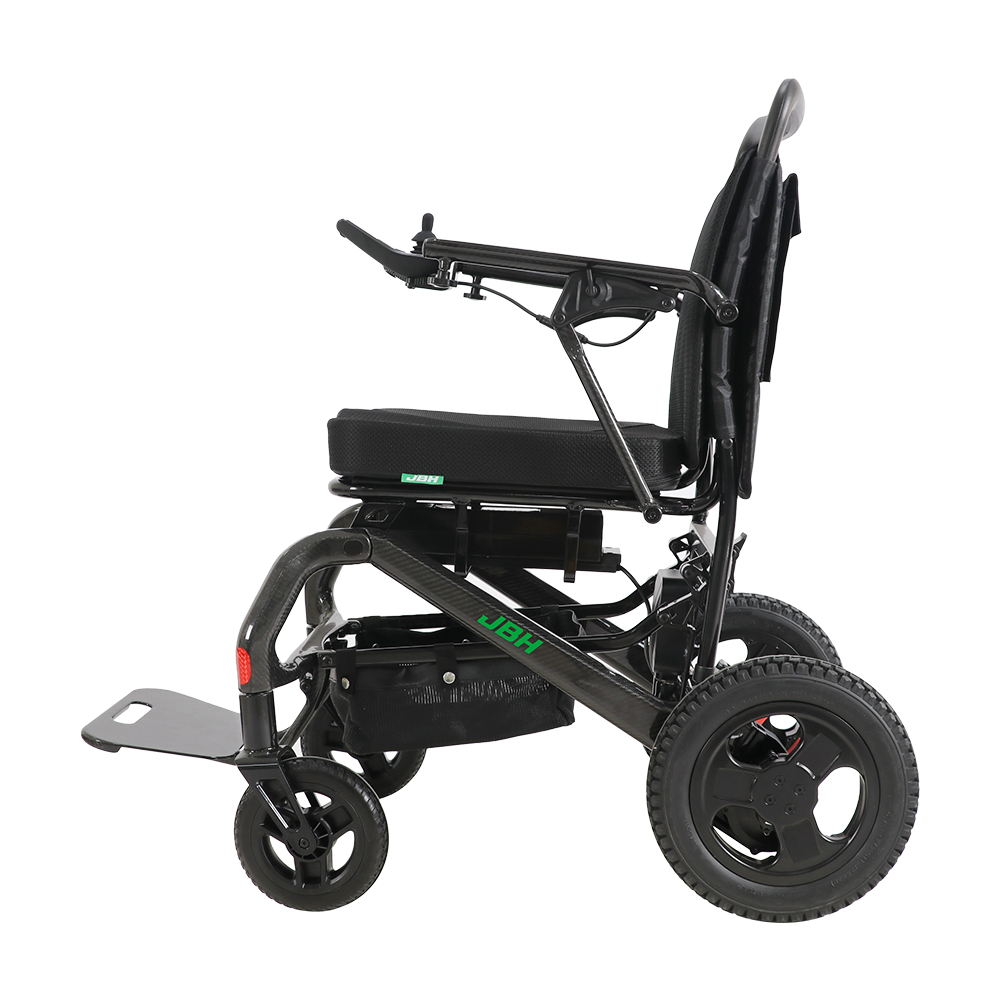
You cannot weld carbon fiber. Traditional aluminum chairs rely heavily on welded joints for stability. Carbon composite requires an entirely different engineering approach. Evaluation of a premium device must focus on its hinge architecture. Aerospace-grade structural adhesives bond the main frame segments together. Engineers reinforce these bonded areas using internal metal sleeves. They also utilize high-grade titanium fasteners at critical folding joints. Titanium prevents galvanic corrosion, which degrades carbon fiber over time. You should always examine the folding mechanism closely. The hinges should operate smoothly without lateral play. Reinforced molding at these junctions dictates the true lifespan of the device.
An ultra-light frame demands a highly specialized powertrain. Manufacturers must pair these frames seamlessly using brushless DC motors. Traditional brushed motors add unnecessary bulk and drain batteries quickly. Brushless designs offer incredible torque while shedding pounds. Evaluating torque requirements is crucial for user safety. The chair must handle standard accessibility inclines, which typically span 8 to 12 degrees. A lightweight frame experiences immense stress if the motors struggle on ramps. Efficient brushless motors deliver immediate power without straining the surrounding composite mounting points. They also operate quietly, enhancing the overall user experience.
Lower mass vehicles behave differently when stopping. A lighter chair carries less momentum. However, it still requires absolute braking precision. Electromagnetic braking systems are non-negotiable for these devices. When the user releases the joystick, the brakes must engage instantly. You must ensure strict stopping distance compliance based on local healthcare regulations. Furthermore, preventing rollback on steep inclines is critical. Chairs carrying lower mass can lose traction easily if the brakes slip. A premium electromagnetic system locks the wheels firmly in place. It guarantees user safety even when the battery is completely depleted.
Travel capability drives the demand for ultra-light mobility devices. Users expect seamless navigation through airports. Therefore, navigating IATA and FAA regulations for lithium-ion batteries is vital. Regulators strictly cap battery capacities for commercial flights. A standard mobility battery must remain strictly under the 300Wh airline limit. Many manufacturers standardize their capacities between 12AH and 20AH. Some brands utilize dual 160Wh systems to maximize range while maintaining flight compliance. You must verify these ratings directly on the battery casing. Airport security will reject batteries lacking clear, stamped certifications.
Aviation Battery Limitations for Mobility Devices
Battery Configuration | Total Watt-Hours (Wh) | FAA/IATA Flight Status | Typical Range |
|---|---|---|---|
Single 12AH (24V) | 288 Wh | Approved (Under 300Wh) | 10 - 12 Miles |
Dual 6AH (24V) | 144 Wh (Each) | Approved (Carry-on allowed) | 10 - 12 Miles |
Single 20AH (24V) | 480 Wh | Not Approved | 15 - 18 Miles |
The electronic brain of the chair controls the user experience. Joystick responsiveness requires highly accurate OEM programmability. A generic controller maps acceleration curves based on heavy steel or aluminum chairs. If manufacturers install this same controller on a carbon composite frame, disaster strikes. The reduced weight causes jerky, aggressive acceleration. It throws the user backward upon starting. Premium manufacturers customize the software algorithms specifically for the lighter mass. This programming ensures gradual acceleration and deceleration. It provides a smooth, predictable ride. You should always test the controller across all speed settings to verify this tailored programming.
Carbon fiber exhibits incredible tensile strength. However, it has specific vulnerabilities regarding blunt force trauma. You must understand these limits clearly. When airline baggage handlers drop a lightweight carbon fiber power chair onto the tarmac, it faces extreme localized impact. This blunt force causes internal micro-cracking. These tiny fractures are often invisible to the naked eye. Over time, they compromise the entire structural integrity of the frame. You must evaluate OEM warranties regarding frame fractures carefully. Reliable manufacturers offer robust warranties covering structural failures. They also reinforce high-impact zones using hybrid kevlar weaves to prevent these catastrophic micro-cracks.
Downtime ruins the mobility experience. Assessing the modularity of the design is a mandatory step for buyers. Can a distributor or user easily replace a broken component? Many cheap models use proprietary, glued-in electronics. If a motor fails, you have to return the entire unit to the overseas factory. This creates unacceptable delays. A quality OEM design prioritizes easy field maintenance. Mechanics should easily swap out a motor, caster, or joystick controller using standard hand tools. Always request a detailed spare parts catalog before committing to a supplier. True modularity protects your long-term investment.
Distributors cannot rely on marketing brochures. You must demand hard engineering data. Requesting comprehensive cycle testing reports is the best defense against poor manufacturing. Reputable factories perform 200,000-cycle drum tests on their frames. These tests simulate years of aggressive driving over varied terrain. Furthermore, you must verify ISO 7176 compliance. This international standard dictates strict requirements for wheelchair stability, braking, and fatigue strength. If a supplier hesitates to provide these unedited lab reports, consider it a massive red flag. Walk away from unverified partnerships immediately.
Different users require entirely different design priorities. You must first identify the primary use case before purchasing. Is the user planning constant travel? If so, prioritize quick-fold mechanisms and the lowest verifiable weight. A travel-focused foldable electric wheelchair needs a rapid folding hinge and airline-compliant batteries. Conversely, does the user need a hybrid daily use chair? Daily users require different features. You should prioritize extended battery range and seat cushion ergonomics. They need thicker foam and adjustable backrests. A travel chair might feel too rigid for ten hours of continuous daily use.
Medical device compliance is not optional. It is a legal and safety mandate. You must protect yourself and your customers by verifying factory credentials. Follow this basic verification checklist:
FDA 510(k) Clearance: Ensures the device meets US safety and efficacy standards for medical equipment.
CE MDR Approval: Verifies compliance with the European Medical Device Regulation.
ISO 13485 Certification: Proves the factory maintains a comprehensive quality management system for medical devices.
Always request documented proof of these certificates. Cross-reference the factory name on the certificate with official government databases to ensure validity.
Finding true value in the mobility market requires strict technical diligence. You must look far beyond the basic weight metrics promoted in glossy catalogs. True value lies firmly at the intersection of premium material grade, smart structural design, and proven electronic reliability. Carbon fiber offers massive benefits, but only when engineered correctly.
Base your final purchasing or sourcing decisions entirely on verifiable factory testing. Demand transparent component sourcing from your OEM partners. Inspect the hinge adhesives, evaluate the controller programming, and insist on comprehensive warranty protection. By focusing on these core engineering realities, you ensure long-term safety and exceptional performance for every user.
A: Carbon composite provides a vastly superior strength-to-weight ratio. It allows the frame to be significantly lighter while maintaining structural rigidity. Additionally, carbon fiber possesses natural shock absorption properties. It dampens everyday vibrations from rough sidewalks much better than rigid aluminum.
A: No. The frame material does not determine flight approval. Aviation authorities strictly regulate the lithium-ion batteries. Your battery must remain under the 300Wh limit to fly commercially. The carbon frame easily passes security, but oversized batteries will face rejection.
A: They are incredibly durable regarding tensile strength. However, they can be vulnerable to direct, localized blunt force. Premium OEMs mitigate this risk. They reinforce high-impact zones, like caster forks, using specialized multi-directional fiber layups to resist daily bumps and drops.
A: No, structural repairs are highly discouraged. When carbon fiber cracks, the internal structural integrity shatters beyond the visible damage. Patching it poses severe safety risks. OEMs strictly advise full part replacement rather than attempting localized repairs on fractured frames.


