

Views: 0 Author: Site Editor Publish Time: 2026-07-15 Origin: Site


Traveling can feel daunting when you rely on heavy, rigid equipment to get around. You want to explore new destinations, but traditional options often trap you into booking specialized transit. A modern foldable travel mobility scooter beautifully addresses these common space constraints. However, buyers face a serious evaluation dilemma before making a final purchase. You must decide whether the motorized folding mechanism of an automated model truly justifies the higher upfront costs and slight weight increases. This guide delivers a transparent, spec-driven framework for your equipment decision process. We will help you evaluate essential lifting requirements, structural limits, and strict airline compliance rules. By the end, you will know exactly how to match the right mobility solution to your specific physical capabilities and lifestyle goals.
Convenience vs. Weight: Automatic folding mechanisms add convenience but typically introduce 5–10 lbs of additional weight due to the internal folding motor.
Travel Compliance is Non-Negotiable: Not all lithium-ion batteries are FAA/airline approved; verification of Watt-hour (Wh) ratings is a mandatory step in the purchasing process.
Redundancy Matters: A reliable automatic folding scooter must feature a manual override in the event of a remote control failure or dead battery.
Sourcing Dictates Longevity: Evaluating the warranty and parts availability of an OEM travel scooter prevents total-loss scenarios when proprietary folding components wear out.
Understanding how a scooter collapses is the first step in making an informed purchase. Manufacturers design these mobility devices to save space. They primarily offer two distinct folding solutions. Each category brings unique trade-offs regarding weight, cost, and physical exertion.
Manual folding models feature fewer moving parts. They generally weigh less and sit at a lower price point. However, operating them requires moderate physical dexterity. You must bend down to engage mechanical levers. You must also pull locking pins to fold or unfold the chassis. This process can frustrate users dealing with arthritis, back pain, or generalized weakness.
Automatic folding models offer a completely different experience. They utilize push-button or remote-controlled operation. A dedicated internal motor handles the physical labor. This setup proves ideal for users lacking grip strength or facing severe spinal mobility limitations. You simply stand back, press a button, and watch the device collapse into a compact shape.
However, automation carries a hidden cost. Buyers often overlook the battery draw of the folding motor. This motor pulls energy directly from the main power source. Frequent folding slightly reduces your overall daily driving range. Furthermore, automation introduces added mechanical complexity. More moving parts mean more potential failure points.
You must also set realistic expectations about the speed of the folding cycle. The process is not instantaneous. A typical mechanical folding sequence takes between 10 and 15 seconds to complete safely. You should never force the chassis closed during this window. Attempting to rush the mechanical sequence can strip the internal gears.
Mechanism Comparison Overview
Feature Category | Manual Folding Mechanism | Automatic Folding Mechanism |
|---|---|---|
Physical Effort | Requires bending, pulling levers, and lifting | Zero physical effort required; operates via remote |
System Weight | Lighter (no internal folding motor) | 5 to 10 lbs heavier on average |
Price Point | More budget-friendly | Premium pricing for electronic integration |
Complexity | Basic hinges and locking pins | Electronic tracks, secondary motors, and wiring |
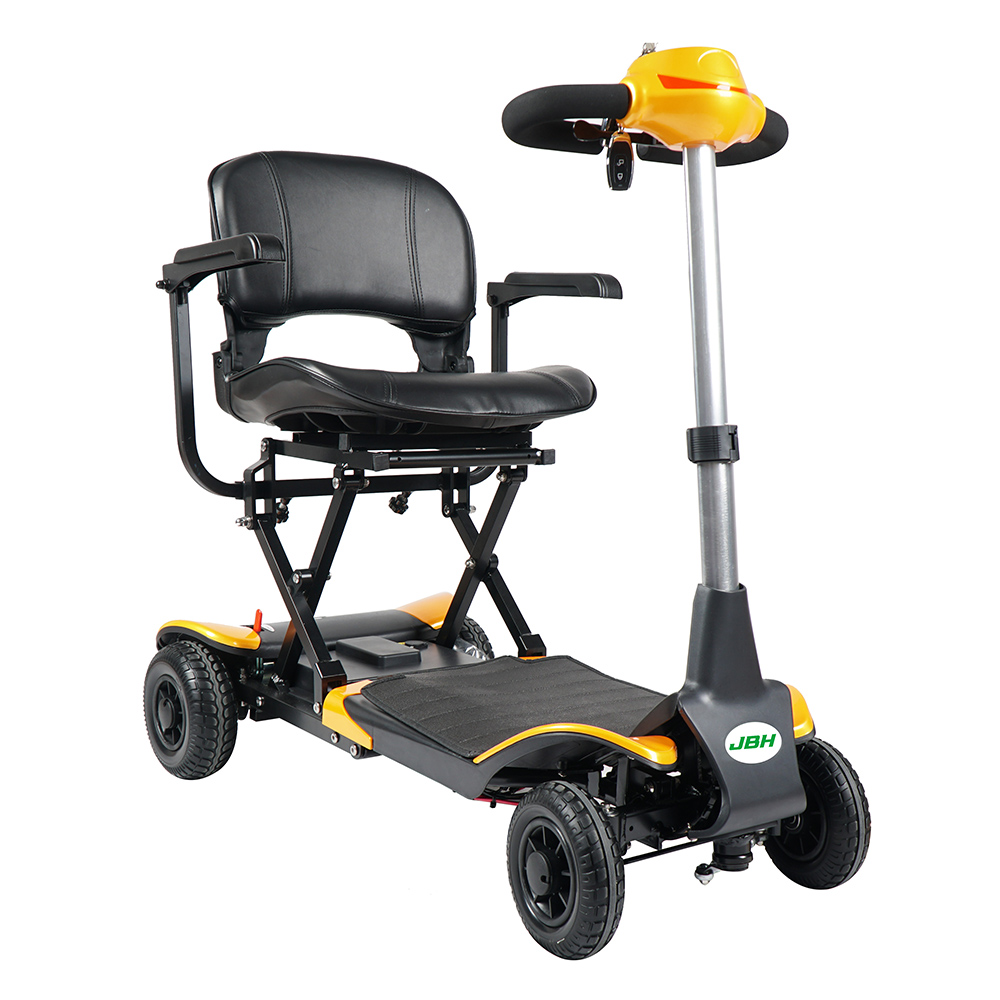
Evaluating an automatic folding travel mobility scooter requires a critical look at daily usage scenarios. Marketing materials often highlight how small a scooter gets. They rarely emphasize the physical reality of lifting it into a vehicle. You must distinguish between the true lifting weight and the total unit weight.
Total weight includes the chassis, the seat, and the battery pack. True lifting weight is the heaviest individual piece you must handle once you remove the battery. A primary decision point emerges here. Can you or your primary caregiver comfortably lift 45 to 60 lbs into a car trunk? We strongly recommend testing your capabilities first. Lift a large bag of pet food or soil of an equivalent weight. If this causes strain, you may need a vehicle hoist rather than relying solely on the folding feature.
Structural integrity deserves equal attention. The folding hinges fundamentally impact chassis rigidity. Manufacturers cut the frame in half to allow it to fold. This design naturally creates stress points. Consequently, most portable models max out at a strict 250 to 300 lbs weight capacity.
Pushing this weight limit has cascading effects. It strains the driving motor and severely limits hill-climbing abilities. It also puts undue pressure on the electronic folding hinges. Exceeding the maximum capacity will eventually warp the frame. This warping prevents the electronic folding mechanism from aligning properly during the closure sequence.
Terrain limitations often surprise new buyers. These devices are strictly designed for paved, ADA-compliant surfaces. They feature exceptionally low ground clearance, usually measuring between 1.5 and 2.5 inches. This low profile keeps the center of gravity stable, but it restricts where you can drive.
Common Terrain Mistakes to Avoid:
Attempting to cross deep gravel driveways.
Driving over thick grass at outdoor parks.
Ignoring steep cruise ship doorway thresholds.
Navigating unpaved airport parking lot extensions.
Understanding these clearance realities prevents buyer's remorse. You will navigate smooth airport concourses and shopping malls effortlessly. You will struggle on uneven cobblestones or soft dirt trails.
Transit compliance forms the cornerstone of hassle-free travel. Federal Aviation Administration (FAA) regulations dictate exactly what you can bring onto an airplane. The primary concern is always the lithium-ion battery. The FAA strictly monitors these power sources due to fire risks in pressurized cargo holds.
For a scooter to fly, its lithium-ion battery must generally fall under a 300 Watt-hour (Wh) rating. Alternatively, airlines may allow you to carry two spare batteries, provided each remains under 160Wh. Gate agents strictly enforce these rules. You cannot place the battery in the cargo hold. You must remove it and carry it into the passenger cabin.
Proper documentation streamlines the boarding process. Never assume a gate agent will take your word regarding battery size. We advise buyers to only shortlist models backed by official compliance documents. You need a downloadable Material Safety Data Sheet (MSDS) or a clear UN38.3 certification. A UN38.3 certificate proves the battery passed rigorous altitude and vibration safety testing. Keep a digital copy on your smartphone and print a hard copy for your carry-on bag.
Cruise ships present a different set of logistical challenges. Storage rules dominate ship life. A cruise cabin is notoriously compact. Your equipment must fit securely inside your stateroom. Cruise lines absolutely forbid leaving mobility devices in the public hallways due to emergency evacuation protocols.
A reliable portable transport scooter must pass through standard cruise cabin doors. These doorways typically measure just 22 to 24 inches wide. A compact folded footprint guarantees you can clear the threshold. Once inside, the folded unit easily tucks into a corner or slides into a closet, preserving your valuable living space.
Relying heavily on electronics introduces distinct implementation risks. Automation is incredibly convenient until it stops working. Buyers must prepare for inevitable technical glitches. The most common vulnerability involves the remote control system.
Users frequently misplace their wireless remotes. Key fobs get dropped, crushed, or simply run out of battery power. If you only have a single remote to operate your automatic folding scooter, a lost fob leaves you completely stranded. The equipment becomes a heavy, unmovable object.
Evaluating redundancy features eliminates this liability. You must look for multiple ways to trigger the folding cycle. A reputable model includes an on-board folding button located on the rear chassis or dashboard. This serves as your secondary switch. More importantly, you need a physical manual release lever. This tertiary override disconnects the folding motor from the frame. It allows you to manually pull the scooter open or closed if all electronics fail. Never purchase a unit stuck in a half-folded state without a manual release.
Maintenance realities also dictate long-term success. Automated folding tracks remain exposed to the environment near the floorboards. As you drive, the tires kick up dirt, hair, and debris. This grime settles directly into the mechanical hinges and electronic tracks.
Preventative Maintenance Best Practices:
Inspect the folding tracks visually after every outdoor trip.
Use a canister of compressed air weekly to blow debris out of the moving joints.
Apply a dry PTFE lubricant to the hinges every few months.
Never use wet, greasy lubricants like standard WD-40, as they attract and trap sand.
The market is flooded with identical-looking scooters carrying different brand names. Many of these are sold by white-label importers. These pop-up companies buy generic units overseas, slap a logo on the plastic shroud, and sell them at a discount. Buying from them introduces massive long-term risks.
When proprietary folding motors break down, you need exact replacement parts. White-label importers rarely stock internal components. Once their inventory clears, your support vanishes. Choosing an OEM travel scooter guarantees a safer investment. An Original Equipment Manufacturer controls their supply chain. They warehouse replacement wiring harnesses, folding motors, and frame hinges for years after the initial sale.
Warranty analysis separates trustworthy brands from risky investments. You must break down the fine print before checking out. A reliable manufacturer offers layered protection across different components.
A trustworthy warranty typically looks like this:
Frame Coverage: Expect 3 to 5 years, or a limited lifetime warranty on the structural metal chassis.
Electronics and Motors: The folding motor, driving motor, and dashboard joystick should carry a 12 to 14-month warranty.
Batteries: Lithium-ion power cells degrade naturally. Acceptable warranties cover defects for 6 to 12 months.
Once you verify the warranty, you can confidently move toward a final decision. We recommend following a strict finalization process to prevent logistical headaches upon delivery.
Next-Step Actions Checklist:
Measure your specific car trunk dimensions against the scooter's folded specifications.
Verify the exact Watt-hour capacity of the battery against your preferred airline's published rules.
Confirm the dealer's return policy, specifically checking for hidden restocking fees or return shipping penalties.
An automatic folding mobility device represents a significant investment in your personal independence. It is best suited for frequent travelers who prioritize ease of use and physical relief over rugged terrain capabilities. By understanding the mechanical trade-offs, you avoid unpleasant surprises regarding weight and ground clearance.
Your ability to lift the folded unit remains the ultimate deciding factor. Always weigh your personal lifting capacity against the scooter's heaviest individual piece before committing. Finally, prioritize transit compliance above all else. Request and verify the lithium-ion battery documentation prior to checkout. This proactive approach ensures you spend your travels enjoying new destinations, rather than arguing with gate agents or struggling with heavy equipment in parking lots.
A: Yes, reputable models include a mechanical release lever or manual override switch. You can disengage the internal motor to fold or unfold the unit by hand. However, you must verify this specific feature before purchase. Cheaper generic models often lack this crucial override, which will leave you stranded if the battery completely depletes.
A: Yes, the scooter itself is permitted in the cargo hold. The battery is the limiting factor. You must remove the lithium-ion battery and carry it into the passenger cabin. FAA compliance dictates the battery must be under 300Wh, or you may carry two spare batteries under 160Wh each.
A: They typically weigh between 45 lbs and 65 lbs including the battery. Keep in mind that "lightweight" is a subjective marketing term. You should physically test your lifting capacity before buying. Try lifting an equivalent weight, like a large bag of pet food, into your car trunk to ensure comfortable daily use.


