

Views: 0 Author: Site Editor Publish Time: 2026-02-12 Origin: Site


Carbon Fiber Wheelchairs may look simple, but their engineering is not.Why do some frames feel lighter and more responsive? Why does aerospace technology matter in daily mobility?In this article, you will learn how composite design, structure, and process choices shape real-world wheelchair performance.
Carbon Fiber Wheelchairs behave differently from metal frames because composites are engineered systems rather than uniform materials. Metal structures respond in broadly similar ways in most directions, so performance tuning usually comes from changing tube size, wall thickness, or alloy. Carbon fiber frames, by contrast, are built from layered structures that can be tuned to respond differently under pushing, turning, and uneven ground, which explains why their handling characteristics often feel distinct even at similar weights.
The first key difference is that carbon fiber is a composite system, not a single material. Its performance comes from fibers and resin working together, with fibers carrying most tensile loads and the resin transferring stress between them. This layered nature allows engineers to design stiffness and strength into specific regions of the frame rather than distributing material evenly everywhere.
The second difference is directionality. Fiber orientation determines where the frame is stiff, where it allows controlled compliance, and how it reacts to torsion. This makes it possible to support efficient propulsion while maintaining stability during turns or when one wheel encounters an obstacle, something that is harder to fine-tune with isotropic metal tubes.
Finally, stiffness-to-weight plays a central role in how the chair feels in use. Higher stiffness relative to mass can make propulsion feel more immediate and reduce energy lost to structural flex, while lower overall weight reduces handling effort during lifting and transport. Importantly, this ratio explains differences in responsiveness, not comfort alone, which is influenced by the entire system rather than the frame in isolation.
Engineering concept | Metal frame baseline | Carbon Fiber Wheelchairs implication |
Material behavior | Uniform, largely isotropic | Layered, tunable by design |
Load response | Adjusted mainly by geometry | Adjusted by fiber direction and layout |
Stiffness-to-weight | Limited by material density | Optimized through composite architecture |
Carbon Fiber Wheelchairs are engineered around how forces move through the frame during real use, not just around how the frame looks. The seat and axle region is the main structural hub because it carries body weight, propulsion reactions, braking forces, and transfer loads repeatedly. Composite design rewards smooth force flow, so good architecture tries to avoid abrupt geometry changes and “hard stops” in the structure that create local stress peaks over time.
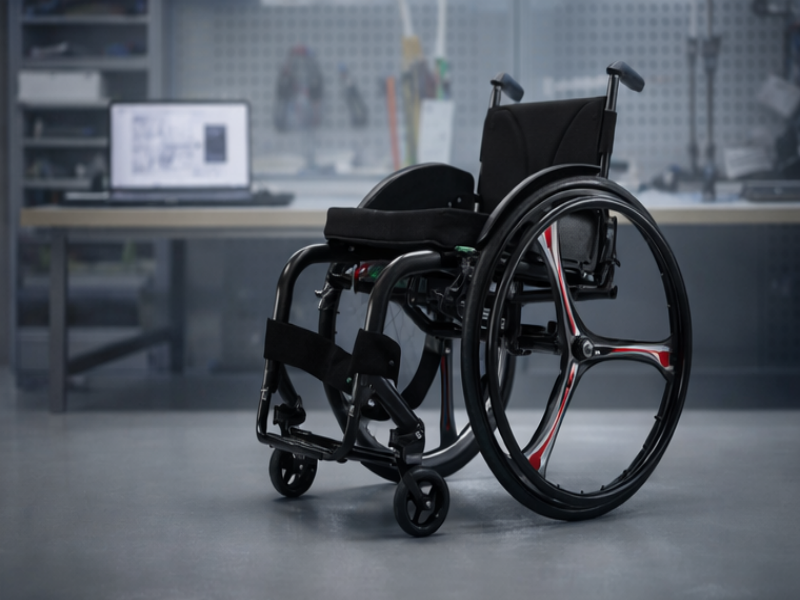
Most daily events load the frame through the same few pathways, which is why this zone dominates both handling feel and durability. During propulsion, the rear area sees bending and torsion; during turns, side loads increase torsion; during transfers, point loads spike around seat supports. In Carbon Fiber Wheelchairs, engineers typically manage this by building continuous fiber routes through the seat and axle area, then adding localized reinforcement only where the load path truly needs it, rather than thickening everything uniformly.
● Propulsion: repeated bending plus torsion around the axle region, where “wasted flex” can reduce responsiveness.
● Transfers: short, high point loads near the seat that can reveal weak local reinforcement.
● Uneven ground: twisting events that test whether torsional stiffness is balanced across the frame. A quick load-path sketch can keep the logic clear and avoid marketing confusion. Think of forces entering at the seat, moving into the main frame, concentrating near the axle supports, and then returning through wheel contact. If any section forces that flow through a narrow junction, it becomes a stress bottleneck that accumulates damage faster than the surrounding laminate.
Frame zone | Dominant daily loads | Why it matters to performance |
Seat region | Compression + transfer point loads | Drives comfort feel and local durability |
Axle region | Bending + torsion from propulsion/turning | Controls responsiveness and tracking stability |
Even in Carbon Fiber Wheelchairs, key functions still depend on metal hardware, so the composite-to-hardware interface is a primary engineering risk area. Inserts are designed to spread load into the laminate and prevent local crushing, peeling, or delamination around holes and mounts. The most important concept is stress transition: the interface should distribute forces gradually into multiple plies instead of concentrating them at a sharp edge. A practical way to evaluate interface robustness is to focus on how the insert is supported by the surrounding laminate. Well-engineered solutions usually increase contact area, align load directions with fiber paths, and reinforce around the insert so repeated cycling does not turn micro-movement into progressive damage. This is also where manufacturing discipline shows up, because a strong design can still underperform if bonding and fit are inconsistent.
● Inserts should spread load into the laminate, not act like a rigid wedge.
● The laminate around inserts should be reinforced for multi-directional loads, not only straight tension.
● Interfaces are often the first place long-term loosening or cracking appears if stress is concentrated.
How carbon fiber wheelchairs are made determines whether the frame matches its engineering intent. Composite performance depends on internal structure, so frames with similar outer shapes can behave differently if their layup, resin content, or curing control differs. Aerospace-derived practice emphasizes repeatable processes that reduce internal defects, because small defects can grow under thousands of daily load cycles.
Layup is where stiffness and strength direction are “built in” through ply orientation and placement. A ply schedule is the structural blueprint: it defines which fiber angles carry propulsion bending, which angles resist torsion during turns and uneven ground, and where local patches protect cutouts and mounts. The key is not more material, but smarter placement that supports the real load paths identified in design. In practical terms, designers often combine lengthwise fibers for primary bending stiffness with angled plies for torsional stability, then add local reinforcement around high-stress zones like mounts. If fibers are misaligned or wrinkle over tight curves, effective stiffness drops and fatigue risk rises, even if the frame looks fine externally. That is why the layup step is both an engineering and a manufacturing control problem.
Curing consolidates the laminate and sets the resin chemistry, locking in mechanical properties and final dimensions. Poor consolidation can leave voids or weak interlaminar bonding, which may not fail immediately but can shorten fatigue life and change stiffness over time. Consistent curing supports predictable stiffness and more stable interfaces, especially around inserts where dimensional accuracy and bonding matter. Rather than focusing on process labels, the decision-relevant point is whether curing is controlled enough to produce repeatable internal quality. If cure control is weak, variability increases, meaning two frames of the same model may not behave the same under load. That inconsistency is the opposite of the “aerospace logic” implied by the title.
Inspection can confirm geometry, surface condition, and obvious fiber distortion, and it can verify that hardware interfaces seat correctly. However, not all internal defects are visible from the outside, particularly small void clusters or early delamination. For Carbon Fiber Wheelchairs, a sensible quality approach relies on prevention and checkpoints during layup and cure, not only on a final visual pass. When evaluating technical credibility, look for whether inspection focuses on structural risk zones such as the axle region and insert areas, because those are where engineering assumptions are most likely to be tested in real use. Cosmetic finish can matter, but it is not a reliable proxy for internal laminate quality on its own.
Build step | Common defect risk | What inspection can realistically catch |
Layup | Misalignment, wrinkles | Some visible fiber distortion, pattern irregularities |
Cure | Voids, weak bonding | Often not visible without advanced methods |
Assembly | Insert stress, poor seating | Fit issues, alignment problems, interface irregularities |
Carbon Fiber Wheelchairs are often judged by a few headline numbers, but the engineering meaning sits behind those numbers. A lower frame mass can improve handling in stop-and-go movement and make lifting or transport easier, yet weight alone does not tell you how the structure behaves under pushing, turning, or impacts. Specs are most useful when you treat them as a map of design choices: where material was removed, where it was added back, and which loads the frame is tuned to resist.
Carbon fiber enables weight reduction largely through structural integration and targeted reinforcement. Instead of adding brackets, gussets, or overlapping tubes, a composite frame can mold load-carrying geometry into the structure and place material only where stresses concentrate. This is why two frames with similar “carbon” labels can differ in real mass and feel: the laminate layout and part-count strategy are the lever, not the label. Key places weight typically disappears in well-engineered carbon frames include joint-heavy regions and areas where a metal design would rely on extra hardware to maintain rigidity. The trade-off is that engineering must preserve stiffness and protect interfaces, otherwise a lighter build can become more sensitive to localized damage.
● Integration reduces part count and overlap, cutting non-structural mass without reducing load capacity.
● Local laminate buildup reinforces stress zones while keeping low-stress spans lighter.
● Hardware planning matters, because inserts and mounts can add weight back if they are overbuilt.
Spec you see | What it usually represents | Common misunderstanding |
Frame weight | Architecture plus part integration and hardware choices | Assuming lighter always means weaker or less stable |
Weight limit | A safety-rated load capacity under defined conditions | Treating it as a predictor of stiffness or ride feel |
Total chair weight | Frame plus wheels, casters, seating, accessories | Comparing totals without matching configurations |
These three properties answer different questions, so they should not be merged into one “stronger” claim. Strength is about the maximum load before failure, stiffness is about deflection under everyday forces, and impact tolerance is about resistance to sudden localized events such as curb strikes or drops. A frame can feel very responsive because it is stiff, yet still require careful design around impact-prone zones where damage is concentrated. For Carbon Fiber Wheelchairs, stiffness tends to drive the day-to-day experience most directly because it affects how much push energy becomes motion rather than structural flex. Strength ratings provide baseline safety assurance, but do not indicate how “tight” the chair feels in turns or how it manages micro-vibrations. Impact tolerance is often dominated by local design around mounts and edges rather than by global frame weight.
● Strength answers “How much load can it survive at once?”
● Stiffness answers “How much does it flex during normal use?”
● Impact tolerance answers “How does it handle sharp, localized shocks?”
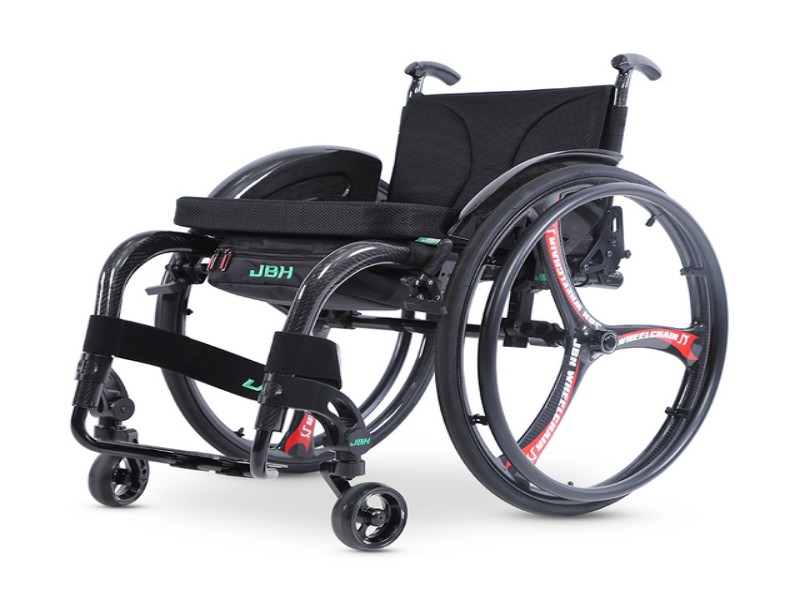
Comfort differences are not just about cushions; vibration is a mechanical pathway from ground to body. Carbon Fiber Wheelchairs can change this pathway because composites dissipate some energy through the resin matrix and layered interfaces, while metals tend to transmit vibration efficiently. The result is typically a shift in how vibration is filtered and how quickly it decays, not a guarantee of a “soft” ride.
Vibration starts at the contact patch and travels through tires and casters before entering the frame at the fork and axle interfaces. From there it couples into the seating system, then into the rider through the backrest, seat pan, and contact points. Because the frame is a main transmission structure, its stiffness distribution and how components are attached influence which frequencies reach the rider more strongly. This explains why changing tires or casters can alter comfort more than expected, even on the same frame. The frame does not generate vibration, but it determines how vibration energy is routed once it enters the structure.
Damping is about energy loss per vibration cycle, not bending more. In composites, micro-level shear in the resin and friction at material interfaces can dissipate energy, so some vibrations die out faster instead of reflecting back through the structure. This can reduce the “buzz” that builds fatigue over time, even when the frame remains stiff enough to feel responsive under pushing. A frame that is simply flexible may feel less harsh but can also feel less precise. The engineering target is usually controlled damping without sacrificing stiffness where propulsion loads dominate.
Perceived comfort is influenced by where stiffness is concentrated and how the frame couples to rolling components and seating. Frames that manage vibration well often avoid abrupt stiffness jumps near mounts, use geometry that reduces high-frequency transmission paths, and maintain stable interfaces that do not rattle or loosen over time. These effects are most noticeable on rough surfaces where repetitive micro-impacts accumulate. In practice, comfort is a system outcome, but the frame’s damping behavior is a core contributor when comparing Carbon Fiber Wheelchairs with similar wheels and seating setups.
Most wheelchair frame damage comes from repeated loading, not single extreme events. Carbon Fiber Wheelchairs face thousands of cycles of pushing, braking, turning, and small impacts, so fatigue resistance depends on how loads are distributed through the laminate and how stress zones are reinforced. Understanding what tends to change first helps interpret durability claims more realistically.
Metal fatigue commonly initiates at welds or stress risers, then grows into visible cracks. Composite fatigue more often appears as gradual local damage that can change stiffness before catastrophic failure, especially near interfaces or tight transitions. That difference makes design and manufacturing consistency central: if fibers are aligned as intended and transitions are smooth, cyclic loads are shared across many fibers rather than concentrated into a small region. A practical implication is that durability is often decided at high-stress zones and interfaces, not in the long straight spans of a frame. Those zones should be treated as the “fatigue budget” drivers in carbon designs.
Environmental exposure mainly affects the resin-rich surface and interfaces over long time scales. UV can degrade surface resin without immediate structural failure, moisture can influence matrix properties, and temperature swings can stress joints between dissimilar materials. Good finishing and material selection aim to slow these pathways so fatigue behavior remains stable across seasons and storage conditions. The key decision takeaway is that long-term durability is not only about fiber; it also depends on resin system, surface protection, and interface sealing quality.
Fatigue resistance improves when engineers reduce stress concentration and keep fiber paths continuous through loaded regions. Common strategies include smoothing geometry at transitions, reinforcing around axle and seat zones, and designing inserts so loads enter the laminate gradually instead of through sharp edges. These choices reduce peak stresses per cycle, which slows damage accumulation and helps the frame retain its handling characteristics longer. A simple way to evaluate the logic is to ask where the highest loads enter and exit the frame, then check whether the structure spreads those loads or funnels them through a narrow interface. Carbon designs that spread loads tend to be more stable over time, even when they prioritize low mass.
Carbon Fiber Wheelchairs show how aerospace engineering improves everyday mobility.
Directional stiffness, load paths, and controlled manufacturing shape real performance.Fiber orientation, interfaces, curing quality, and fatigue behavior define durability.
These factors decide whether low weight delivers stable handling and comfort.JBH Medical applies these principles to develop wheelchairs that focus on reliability, efficiency, and long-term user value.
A: Carbon Fiber Wheelchairs use directional composites, improving stiffness-to-weight and reducing energy loss.
A: Carbon Fiber Wheelchairs rely on controlled fiber orientation, reinforced interfaces, and fatigue-aware design.
A: Carbon Fiber Wheelchairs require precise layup, curing control, and inspection to ensure repeatable performance.
A: Carbon Fiber Wheelchairs should be assessed by load paths, interface design, curing quality, and fatigue behavior.


