

Views: 0 Author: Site Editor Publish Time: 2026-07-13 Origin: Site


Buyers face a tough dilemma today when shopping for personal mobility aids. The market aggressively pushes ultra-lightweight travel scooters for active lifestyles. However, manufacturers frequently sacrifice critical ergonomic support just to achieve much smaller folding dimensions. Anyone needing prolonged daily operation quickly realizes the physical flaw in this minimalist trend. A standard backless travel seat accelerates lumbar fatigue significantly during extended outings. For these active users, securing a solid, structural backrest becomes absolutely non-negotiable for long-term health. We developed this comprehensive guide to help you navigate these specific design compromises effectively. You will discover a realistic, evidence-based framework for evaluating a compact mobility scooter with backrest before making a purchase. It effectively balances your need for essential ergonomic support against actual daily transportability requirements.
Adding a structural backrest fundamentally alters a scooter’s folding mechanism and total weight—expect an additional 3–8 lbs compared to backless models.
Not all backrests provide true support; buyers must differentiate between rigid lumbar supports and flimsy fabric bands.
When evaluating a foldable mobility scooter, the center of gravity shifts slightly with a backrest, impacting incline stability.
Understanding OEM mobility scooter production variations helps identify which brands offer genuine seat quality versus generic, white-labeled frames.
Standard compact models prioritize a completely flat-fold footprint above all else. Engineers design them to slide effortlessly under beds or into tight storage compartments. Integrating a physical backrest disrupts this minimalist geometry entirely. Adding this support requires distinct hinge mechanisms to allow the seat assembly to collapse. These structural additions often complicate the overall folding process. You trade a few seconds of quick-fold convenience for hours of physical comfort.
You must also account for the realistic weight additions. A robust seat assembly adds substantial hardware to the chassis. A comfortable transport scooter will naturally weigh more than a bare-bones travel model. Expect an increase of roughly three to eight pounds. Buyers must learn to calculate lifting weight rather than merely looking at total assembled weight. Lifting weight subtracts the removable battery and any detachable seat components. You should focus purely on the heaviest single piece you must lift into a vehicle.
Elevating the backrest fundamentally shifts your weight distribution backward. This physical reality changes the overall center of gravity. When you recline slightly against the support, you move the balance point closer to the rear axle. This shift directly impacts incline stability. Navigating steep driveway aprons or standard ADA ramps becomes slightly riskier without proper precautions. Therefore, you must insist on anti-tip wheels when selecting these specific models. They provide a critical fail-safe against backward tipping during uphill navigation.
Common Mistake: Many buyers purchase a model based solely on its total weight specification. They fail to test how the backward weight shift feels during actual acceleration.
You will typically encounter two distinct profiles when shopping for travel models. Low-profile backrests support the lower lumbar region only. They fold down easily and keep the folded footprint relatively compact. Mid-back supports promote much better upper body posture. However, they are inherently bulkier and harder to transport. You must decide which support level your daily routine demands.
Proper lumbar alignment also relies heavily on ideal seat depth. Seat depth determines how your legs rest when you lean back fully. Deep seats cause severe thigh compression behind your knees. This restricts blood flow during prolonged rides. You need adequate clearance between the seat edge and your calves. Perfect seat depth allows you to sit firmly against the backrest while keeping your feet planted securely on the floorboard.
Backrest Profile | Support Level | Folding Impact | Best For |
|---|---|---|---|
Low-Profile | Lower lumbar region only | Minimal space required | Short trips, flat terrain |
Mid-Back | Lumbar and mid-spine | Adds 4-6 inches to folded height | Extended use, uneven terrain |
Fabric Band | None (Cosmetic) | Zero impact | Ultra-light travel only |
Beware ultra-thin vinyl padding disguised as ergonomic support. This cheap material often bottoms out completely after just 30 minutes of use. You will eventually feel the rigid metal frame pressing directly into your spine. This defeats the entire purpose of having a backrest.
We strongly recommend high-density foam for continuous daily use. It maintains its structural integrity over long distances. Alternatively, breathable mesh provides excellent support while reducing overall weight. Temperature regulation impacts your overall comfort significantly. Solid vinyl seats trap body heat and sweat. Breathable materials keep you cool during outdoor summer navigation.
You should evaluate the importance of tilt-adjustable mechanisms. Some users need to lean back slightly to relieve spinal pressure. Height-adjustable features also prove incredibly valuable for taller individuals. However, highly adjustable seats remain exceptionally rare on compact models. Engineers struggle to combine complex adjustments with simple folding mechanisms. Finding a compact model offering multiple seat adjustments serves as a very strong buying signal. It indicates superior engineering and thoughtful user-centric design.
Best Practice: Always test the seat cushioning by pressing your thumb firmly into the center. If you can easily feel the hard backing plate, the foam lacks sufficient density for prolonged use.
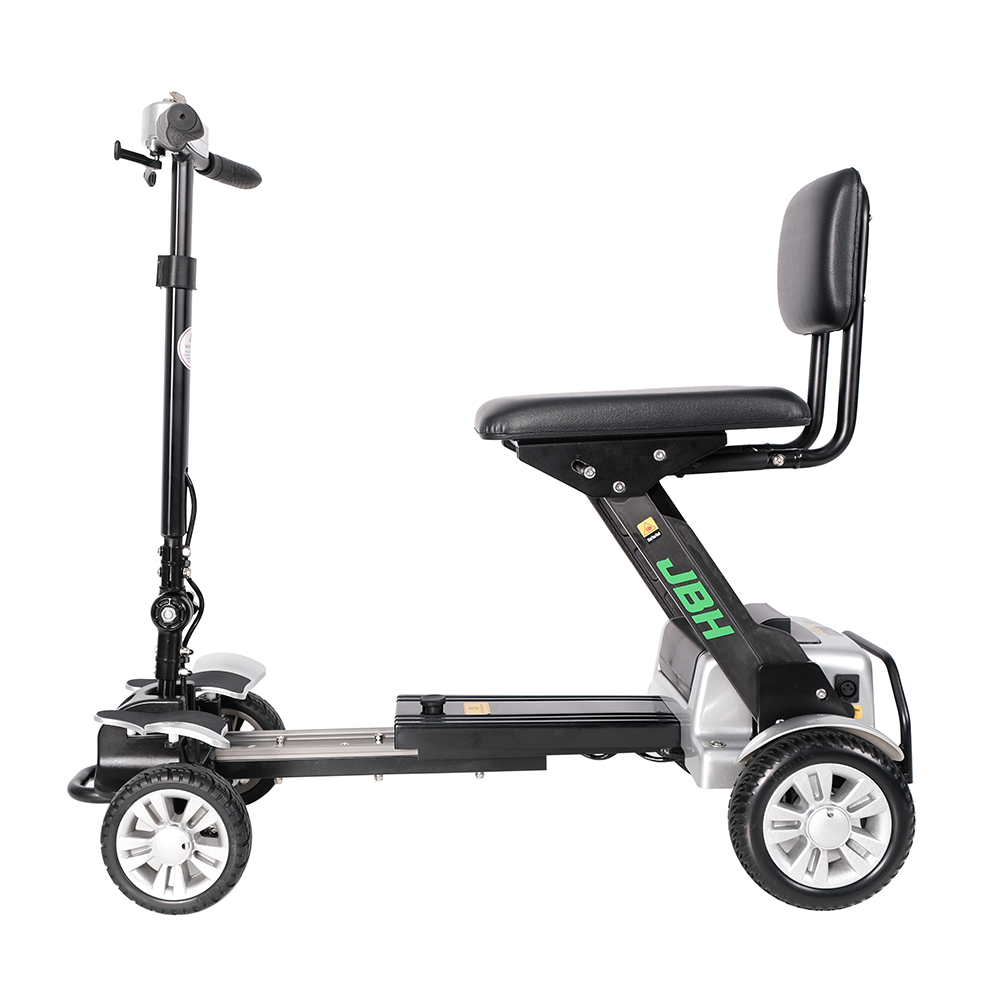
When examining a backrest mobility scooter, you must understand how the folding geometry actually works. The inclusion of a seatback introduces mechanical complexity. Manufacturers solve this problem using two distinct approaches. Each carries specific benefits and operational risks.
Auto-folding models often feature a synchronized mechanical fold. You push a button on a remote control. The backrest automatically collapses forward directly into the floorboard. The steering tiller then lowers itself. This provides ultimate convenience for users lacking hand dexterity. However, moving parts carry inherent risks. They are highly prone to mechanical failure if jammed. Debris trapped in the electronic track can disable the entire unit. You might find yourself stranded unable to fold the device.
Manual folding mechanisms require physical intervention. You usually pull a spring-loaded pin or release a lever. You fold the backrest down manually first. Then, you collapse the steering tiller over the seat. The primary benefit here is higher reliability. Fewer electronic components mean fewer potential breakdowns. Furthermore, manual designs usually support much thicker backrest padding. Engineers do not have to worry about tight motorized clearance tolerances.
You must provide standard spatial dimensions when loading these devices into vehicles. Even folded flat, a unit carrying a backrest adds several inches to the vertical profile. A standard sedan trunk requires at least 18 to 22 inches of vertical clearance. Measure your trunk opening carefully before purchasing. Do not rely solely on the interior trunk volume. The actual opening often restricts loading.
For users intending to fly, FAA and TSA compliance remains crucial. Interestingly, the seat size does not impact flight approval whatsoever. Battery capacity determines air travel compliance. You usually need a lithium-ion battery under 300Wh to board a commercial flight. Always detach the battery and carry it into the passenger cabin. You can gate-check the folded scooter just like a traditional wheelchair.
The white-label reality dominates the modern mobility industry. Many foldable models share identical base chassis designs. Massive factories in Asia produce these core frames. Buying an OEM mobility scooter means you might spot similar exteriors across several competing brands. Do not let this discourage you. The frame itself usually features excellent, stress-tested geometry.
You must understand exactly where premium brands differentiate themselves. The electric motor and aluminum frame might match across three different companies. However, the seat assembly varies drastically. Premium brands specify higher-grade components during assembly. They invest in superior backrest quality, better locking hinges, and high-tier battery cells. They upgrade the upholstery from cheap vinyl to durable, moisture-wicking fabrics.
Sourcing compliance separates reputable importers from transient drop-shippers. Advise buyers to look strictly for CE and FDA medical device certifications. These certifications prove the manufacturer subjected the frame to rigorous structural testing. Domestic warranty support also plays a vital role. You want a company holding replacement parts in a local warehouse. Avoid brands forcing you to ship the entire unit overseas for basic repairs.
Common Mistake: Purchasing the cheapest version of a recognizable frame design. You often sacrifice the upgraded high-density seat cushion and the reliable battery cells.
Defining your personal success criteria simplifies the buying process. You must clearly identify your primary use case. Are you navigating narrow cruise ship hallways and crowded airport terminals? You need the tightest possible turning radius and a very compact fold. Are you running daily neighborhood errands? You should prioritize superior suspension and maximum seat depth over absolute portability.
Evaluate your physical capacity honestly. Can you or your caretaker comfortably lift the heaviest piece? Even on a compact foldable mobility scooter, you must handle significant weight. The heaviest component often reaches 30 to 45 lbs. Practicing a simulated lift using household items helps gauge your true capability.
Examine the locking mechanism: Does the backrest lock securely in the upright position? Avoid models exhibiting play or wobble at the backrest hinge. A loose hinge causes instability on uneven terrain.
Verify the seat width: Is the seat width adequate? You want to prevent the armrests from pinching your hips. Tight armrests cause severe chafing during long rides.
Inspect the tire material: Are the tires solid or pneumatic? Pneumatic tires add necessary riding comfort by absorbing vibrations. Solid tires reduce routine maintenance by preventing flat tires.
Your next steps involve physical validation. We highly recommend testing similar seat types locally if possible. Visit a medical supply showroom to sit in various models. Pay attention to how the lumbar support hits your lower back. If local testing proves impossible, purchase strictly from vendors offering transparent return policies. Look for companies charging zero or very low restocking fees. This protects you if the ergonomics do not match your body type.
Purchasing a compact model with a backrest requires accepting a slight compromise on absolute minimum weight in exchange for necessary physical support.
Prioritizing a high-quality folding hinge ensures the seat mechanism remains reliable over years of daily collapsing and expanding.
Selecting high-density foam over purely cosmetic features yields the best long-term return on your investment and guarantees daily comfort.
Always calculate the true lifting weight rather than assembled weight to ensure you can independently load the device into your vehicle.
A: Most backrests fold down neatly to meet the seat cushion. However, they rarely achieve a perfectly flat profile. The hinge and padding typically add 4 to 6 inches of vertical height to the folded dimensions. You must account for this extra bulk when measuring your vehicle's trunk space for storage.
A: We strongly advise against this. Most ultra-light frames are not structurally tested to handle the rearward torque generated by an aftermarket backrest. Adding one can severely alter the center of gravity, increasing tipping risks. Furthermore, drilling into the frame usually voids all manufacturer warranties immediately.
A: Standard industry weight capacities typically range from 250 to 300 lbs for these compact models. Keep in mind that consistently operating the device near its maximum weight limit will significantly reduce your overall battery range and put extra strain on the folding hinges.
A: The scooter itself does not determine flight compliance; the battery does. The FAA and TSA regulate lithium-ion batteries. Typically, batteries under 300Wh are approved for cabin travel. The size of your seat or backrest does not restrict you from gate-checking the device before boarding.


