

Views: 0 Author: Site Editor Publish Time: 2026-02-21 Origin: Site


What happens when your wheelchair suddenly will not move at all? A dead wheelchair battery can stop daily life without warning.
This guide explains how to charge a dead wheelchair battery safely. You will learn clear steps, timing expectations, and when charging should stop.
Before attempting to charge a dead wheelchair battery, it is critical to determine whether charging is safe at all. A battery that is physically compromised or charged in poor conditions can pose fire, chemical, or electrical risks. This section focuses only on go / no-go checks that help you decide whether charging should proceed or stop immediately, based on visible condition and basic setup factors rather than tools or advanced diagnostics.
Start with a careful visual inspection of the wheelchair battery and its immediate surroundings. Physical damage is one of the clearest indicators that a battery should not be charged, regardless of how low the charge level is. Swelling or bulging usually signals internal gas buildup or cell failure, which can worsen rapidly during charging. Leaks, residue, or corrosion around the casing or terminals may indicate electrolyte escape, increasing the risk of chemical burns or short circuits.
Cracks in the battery casing or burn-like heat marks are also serious warning signs. These often suggest previous overheating, impact damage, or internal shorting. Charging a battery in this state can accelerate failure or trigger thermal events. If any of these signs are present, charging attempts should stop and the battery should be evaluated or replaced rather than revived.
The table below summarizes visible warning signs and their safety implications:
Visible Sign | What It Indicates | Charging Decision |
Swelling or bulging | Internal pressure or cell damage | Do not charge |
Fluid leaks or residue | Electrolyte leakage or seal failure | Do not charge |
Cracks or deformed casing | Structural damage | Do not charge |
Burn marks or discoloration | Past overheating or short circuit | Do not charge |
If none of these conditions are observed, the battery may still be deeply discharged but structurally intact, which is a necessary baseline for safe charging.
Once the battery passes a physical inspection, the next check is the charging environment itself. Even a healthy wheelchair battery can become unsafe if charged under poor conditions. The wheelchair should be completely powered off to prevent load interference or electrical feedback during charging. Charging while the chair is active or partially powered can confuse charger detection and increase stress on the battery.
The battery and charger should be placed on a stable, non-flammable surface in a well-ventilated area. Ventilation matters because certain wheelchair battery types can release heat or trace gases during charging, especially after deep discharge. Avoid enclosed spaces, soft surfaces, or areas near heat sources. A standard grounded wall outlet should be used, as extension cords, power strips, or unstable power sources can introduce voltage fluctuations.
Key setup essentials to confirm before charging include:
● The wheelchair is fully powered off and stationary
● The charging surface is flat, dry, and non-combustible
● The area has adequate airflow
● The outlet is a normal, grounded household socket
Completing these checks does not guarantee that a dead wheelchair battery will successfully charge, but it significantly reduces preventable risks. Only after both the physical condition and charging setup meet these criteria should the charging process begin.
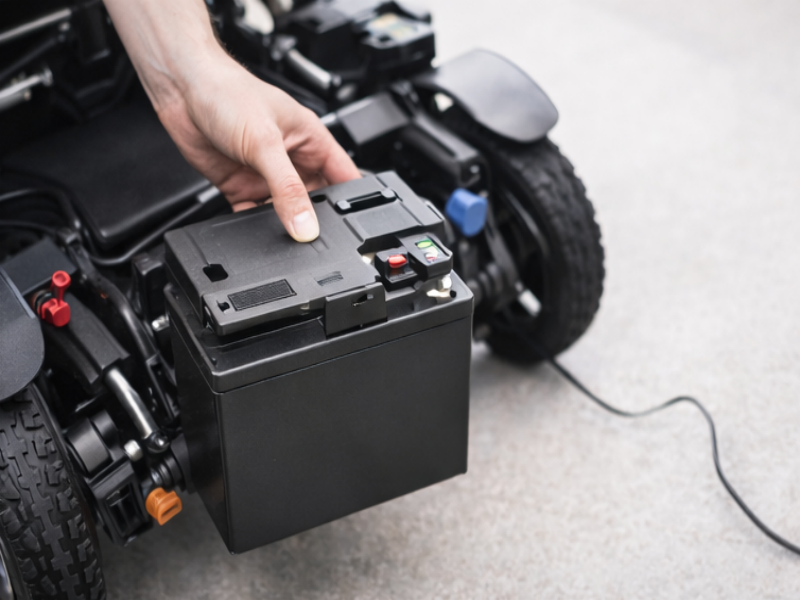
Charging a dead wheelchair battery should always follow a standard, manufacturer-aligned process. This method prioritizes safety, battery protection, and predictable outcomes, especially when the battery has been deeply discharged. While alternative techniques exist, the standard method remains the most reliable starting point and is the only approach recommended for routine use.
The charger must match both the voltage rating and battery chemistry of the wheelchair battery. Wheelchair batteries are commonly designed around specific charging profiles, and chargers are calibrated to deliver current and voltage in stages that align with those profiles. Using a mismatched charger may prevent the battery from initiating a charge at all, or worse, force current in a way that accelerates internal damage.
A correct charger also includes safety controls such as current limiting and automatic shutoff, which are especially important when the wheelchair battery has reached very low voltage. Generic or automotive chargers often lack these controls and can overheat the battery or cause unstable charging behavior.
The table below highlights why charger compatibility matters:
Charger Match Factor | Why It Matters During Charging | Potential Risk if Mismatched |
Voltage rating | Ensures the battery can accept charge | No charging or overvoltage |
Battery chemistry | Controls charge curve and cutoff | Capacity loss or damage |
Current control | Prevents overheating | Excess heat or swelling |
Ensuring charger compatibility is the foundation of safe charging and should always be confirmed before proceeding.
Once the correct charger is confirmed, the connection sequence should be followed carefully. This reduces the risk of electrical arcing, controller errors, or interrupted charging cycles. The process itself is simple, but skipping or reordering steps can cause the charger to fail to recognize the wheelchair battery.
The basic sequence is:
● Make sure the wheelchair is powered off and stationary
● Connect the charger to the wheelchair’s charging port or battery connector
● Plug the charger into a grounded wall outlet
● Confirm that the charger indicates active charging
After charging begins, avoid moving the wheelchair or disconnecting cables unnecessarily. Interruptions during the early stage can confuse the charger’s detection logic, especially with a deeply discharged wheelchair battery, and may require restarting the process from the beginning.
The first hour of charging a dead wheelchair battery often progresses slowly, and this is typically normal. Many chargers start with a low-current phase to stabilize the battery before increasing output. Indicator lights may remain in a “charging” state longer than expected, and voltage recovery may be gradual rather than immediate.
Normal early-stage behavior usually includes:
● Charger indicator showing active charging without switching to “full”
● Slight warmth around the battery casing, but no hot spots
● No unusual smells, hissing sounds, or visible deformation
What should not happen is just as important. Rapid heating, sharp odors, swelling, or flashing fault indicators are signs to stop charging immediately. These symptoms suggest the wheelchair battery is not responding safely and may be internally damaged. Monitoring the first hour closely provides an early safety check before committing to a full charging cycle.
When a wheelchair battery shows no sign of charging after being correctly connected, the issue is often related to voltage level, charger detection, or battery condition rather than the charging process itself. This section focuses only on immediate, practical checks that help determine whether the battery is responding at all or whether charging should stop to avoid damage.
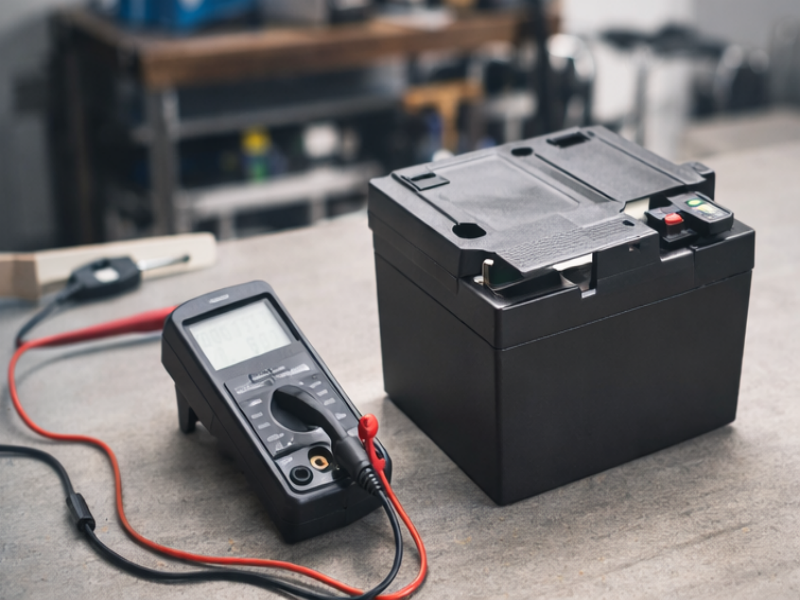
A basic voltage check can quickly clarify whether the wheelchair battery is deeply discharged or completely unresponsive. Using a simple multimeter, measuring the battery’s terminal voltage provides insight into whether the charger is likely to recognize the battery. Extremely low readings often explain why charging does not start, as many chargers include a minimum voltage threshold for safety reasons.
A battery showing very low but measurable voltage may still recover slowly once charging begins, while a reading near zero usually indicates severe depletion or internal failure. Rechecking voltage after a short charging attempt can also show whether the battery is responding, even if charger indicators have not changed yet.
Typical voltage observations and what they suggest are summarized below:
Voltage Reading (Relative) | What It Suggests | Charging Outlook |
Measurable but very low | Deep discharge | May recover slowly |
Near zero | Severe depletion or damage | Low recovery chance |
No change after time | No response | Stop charging |
Charger indicators provide immediate feedback, but they are often misunderstood. Most chargers use simple light or symbol patterns to communicate status rather than detailed diagnostics. A steady “charging” signal usually means the charger has detected the wheelchair battery and is delivering current, even if progress appears slow.
A “full” or completed indication should only appear after a stable charging period, not immediately after connection. If a charger shows a fault or no-light condition repeatedly, it often means the battery voltage is outside the acceptable range or the charger has detected an abnormal condition. These signals should be interpreted as safety feedback rather than errors to override.
Understanding indicator behavior helps avoid unnecessary repeated reconnecting, which can interrupt early recovery stages for a deeply discharged wheelchair battery.
There are clear situations where continued charging attempts are unsafe or ineffective. If the wheelchair battery becomes hot to the touch, emits unusual smells, shows visible swelling, or triggers repeated fault indicators, charging should stop immediately. These signs suggest internal problems that charging cannot correct.
Another stop condition is lack of measurable improvement. If voltage does not increase at all after a reasonable charging attempt, further effort is unlikely to succeed and may increase risk. In these cases, professional evaluation or battery replacement is the safer path. Recognizing when to stop is as important as knowing how to start charging, as it protects both the user and the wheelchair system from preventable damage.
Charging time is one of the most common concerns after a wheelchair battery has been fully discharged. There is no single universal duration, because recovery time depends on both the battery’s condition and the charging setup. This section focuses only on realistic time expectations and the factors that influence them, helping readers avoid unnecessary worry or premature disconnecting.
In most cases, a fully discharged wheelchair battery requires a full, uninterrupted charging cycle, which commonly falls within a broad overnight window rather than a quick recharge. Deep discharge forces the charger to begin at a lower current level, extending the total charging time compared to routine top-ups. Older batteries or those with reduced capacity often take longer, even if they never quite reach their original performance.
Charging time is mainly shaped by a small set of variables that work together. Battery capacity determines how much energy must be restored, while battery age and health influence how efficiently that energy is accepted. Charger output also plays a role, as lower amperage chargers prioritize safety over speed, especially during early recovery stages.
The table below summarizes how these factors affect charging duration:
Factor | Effect on Charging Time |
Depth of discharge | Deeper discharge increases total time |
Battery age/health | Older or worn batteries charge more slowly |
Battery capacity | Higher capacity requires longer charging |
Charger output | Lower output extends charging duration |
Because these factors vary, it is normal for charging after a full discharge to take noticeably longer than everyday charging routines.
Rather than relying on time alone, it is more reliable to look for practical signs that the wheelchair battery is ready for use. A completed charge is typically indicated by the charger showing a stable “full” or “complete” status after several hours of uninterrupted charging. This suggests that the battery has reached its target voltage and the charger has transitioned out of active current delivery.
Beyond charger signals, real-world performance matters. When the wheelchair powers on normally, responds smoothly to controls, and maintains consistent movement during a short test drive, these are strong indicators that the battery has reached a usable charge level. If performance drops quickly or warning indicators appear soon after unplugging, the battery may require further charging or may no longer hold sufficient capacity.
Judging readiness by both charger feedback and brief functional testing provides a more accurate picture than watching the clock alone, especially after a deep discharge event.
Charging a dead wheelchair battery requires patience and correct steps.
Safety checks, proper chargers, and clear stop signs prevent damage.
Some wheelchair battery failures cannot be recovered by charging alone.
JBH Medical provides reliable wheelchair battery solutions and trusted support.
A: Yes, a wheelchair battery can be recharged if it is deeply discharged but not physically damaged or overheated.
A: Charging a dead wheelchair battery typically takes 8–14 hours, depending on battery age, capacity, and charger output.
A: A wheelchair battery may not charge if voltage is too low, the charger is incompatible, or internal damage is present.
A: A wheelchair battery should be replaced if it shows swelling, leakage, strong odor, or no voltage recovery after charging.


