

Views: 0 Author: Site Editor Publish Time: 2026-09-09 Origin: Site


Selecting the wrong transfer equipment increases the risk of caregiver injury and patient falls. Every year, countless families face physical strain because they misunderstand their mechanical support needs. We often see well-meaning buyers purchase a device based on aesthetic appeal or perceived convenience. However, they soon realize the equipment actively harms the caregiving process.
The decision between a sit-to-stand and a full-body lift isn't about preference. Instead, it is dictated strictly by the patient’s physical capabilities, cognitive state, and the physical constraints of the care environment. You cannot safely force a passive patient into an active transfer device. Likewise, using a passive device for a patient who can still bear weight might accelerate their muscle decline.
This article provides a clinical-grade, decision-stage framework. You will learn how to evaluate transfer equipment based on safety compliance, long-term viability, and actual homecare realities. We will guide you through occupational therapy assessments and environmental checklists to ensure safe transfers.
Capability Dictates Category: Sit-to-stand lifts require the patient to bear partial weight and follow instructions; full-body lifts assume zero weight-bearing ability.
Sling Selection is Critical: The lift motor does the lifting, but the sling interface determines patient safety and skin integrity.
Environment Matters: A standard full-body lift requires significant turning radius, making a foldable electric patient lift a necessary consideration for tight residential spaces.
Plan for Progression: Degenerative conditions often necessitate a transition from active (sit-to-stand) to passive (full-body) lifts over time.
When families begin researching mechanical aids, they often feel overwhelmed by the vast array of options. The most vital step involves understanding the fundamental difference between active and passive transfers. You must carefully evaluate the person receiving care. Differentiating between patients who can actively participate in their transfer versus those requiring total mechanical support sets the foundation for your equipment choice.
An active transfer implies the individual can contribute physical effort. They might push up with their legs, grip handles tightly, or shift their center of gravity upon request. A passive transfer means the equipment does all the work. The individual remains completely supported in a suspended state. You must objectively define this baseline need before looking at specific models.
Clinical professionals use standardized frameworks to determine mobility levels. Occupational therapists routinely perform these assessments to prevent adverse events. We can borrow their evaluation criteria to make informed decisions at home. You should ask four specific questions about the person you plan to move.
Weight-bearing capacity: Can the patient support at least 25% of their body weight on one or both legs? This metric is non-negotiable for active devices. They must possess enough lower-body strength to stand partially. If their knees buckle immediately upon bearing weight, they fail this check.
Trunk control: Can they sit upright unassisted on the edge of a bed? Trunk stability ensures they will not slump forward or slide out of a specialized harness. We rely on core strength to maintain a safe posture during lifting motions. Without it, upper-body support straps become dangerously restrictive.
Cognitive function: Can they reliably understand and follow physical commands during the transfer process? Mental acuity matters just as much as physical strength. They must comprehend instructions like "hold this bar," "lean back," or "do not let go." Sudden confusion or panic midway through a maneuver often leads to catastrophic falls.
Decision Gate: Evaluate the answers to those three questions carefully. If the answer to any of the above is "no" or "inconsistent," a sit-to-stand lift is generally contraindicated. You must proceed directly to full-body solutions. Do not gamble on "good days" versus "bad days" when safety is at stake.
These devices bridge the gap between complete independence and total reliance. They require user participation, making them highly specialized tools. When applied correctly, they dramatically reduce the physical toll on caregivers while promoting user autonomy. Understanding how they operate helps you avoid misapplications.
Mechanism of Action: This equipment utilizes a specialized sling positioned around the torso. It wraps securely behind the lower back and fastens beneath the arms. As the machine activates, it pulls a semi-weight-bearing patient forward and upward into a standing posture. The individual rests their feet on a stable platform. Their shins press against padded knee blocks for leverage. They hold onto handles while the machine raises them.
You will find these active machines incredibly beneficial in specific scenarios. They shine when the user retains partial mobility. Clinicians favor them for several distinct applications.
Rehabilitation environments promoting mobility retention: Physical therapists use them daily. Regular standing helps maintain bone density. It also encourages blood circulation and muscle engagement. By forcing the user to bear weight, the machine slows physical deconditioning.
Toileting and hygiene transfers: Standard hammocks complicate bathroom visits. A torso harness leaves the lower body completely free. This design allows caregivers easy removal of lower garments. It makes transferring onto a commode highly efficient and dignified.
Patients with temporary lower-extremity weakness: Post-surgical recovery often involves transient weakness. If the individual possesses strong upper body and core stability, they can safely use this device until their legs recover fully.
Despite their benefits, these machines carry distinct dangers. You must remain vigilant about contraindications. Misusing them places immense stress on vulnerable body parts.
The primary danger involves the risk of knee-buckling if patient strength fluctuates. Some individuals experience sudden muscle fatigue. If their legs give out mid-lift, the entire weight shifts to the torso harness. This shift creates severe chest compression risks. We must protect patients with respiratory issues, severe osteoporosis, or frail ribs. The upward pulling force can easily bruise tissue or fracture bones if the legs fail to support the intended load.
Furthermore, this equipment is entirely unsuitable for uncooperative patients. Those suffering from severe dementia or delirium might attempt to sit back down while the machine pulls them up. They might push away from the handles or thrash around. This unpredictable behavior ruins the required center of gravity, risking tipping or slipping.
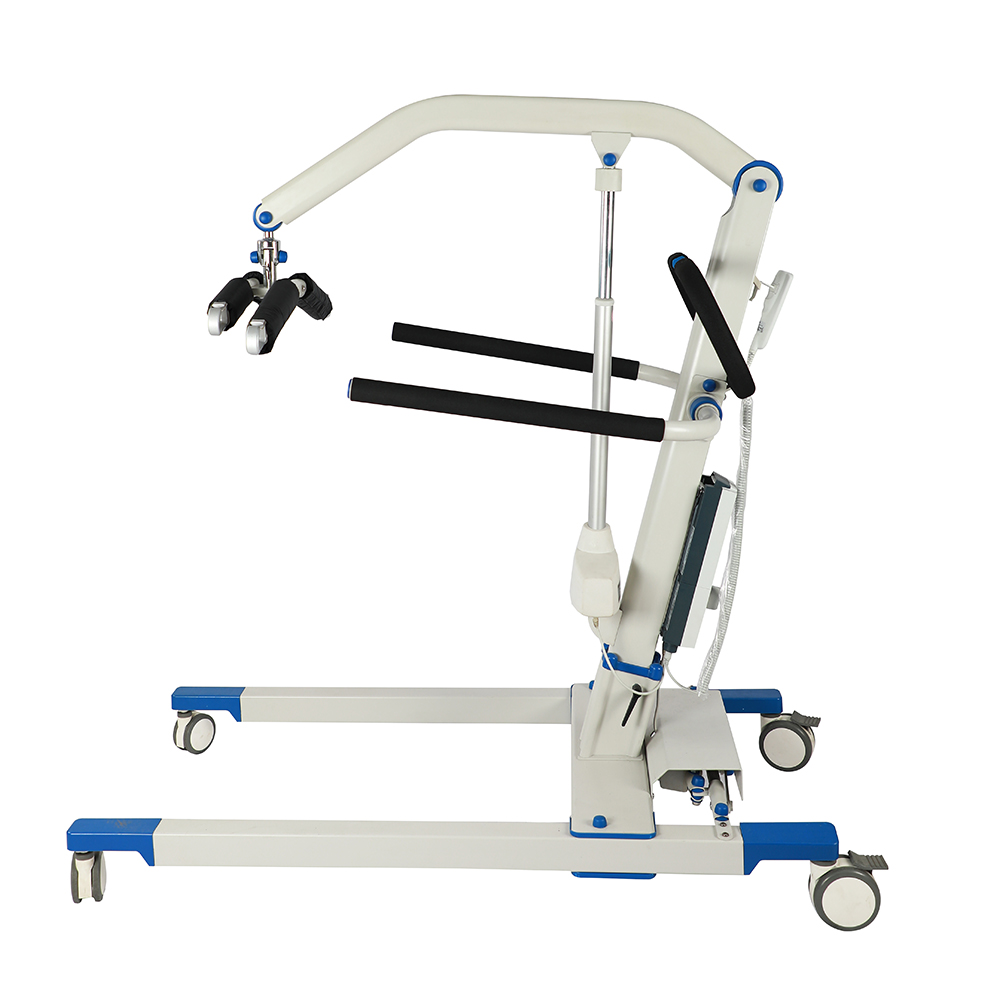
When physical contribution becomes impossible, we turn to passive mechanical solutions. These heavy-duty frames manage the heaviest loads safely. Operating a standard patient lift designed for full-body support completely removes the physical burden from the person being moved. They act as essential lifelines for complex caregiving scenarios.
Mechanism of Action: Often referred to as Hoyer-style lifts, these utilize a U-sling or full hammock sling to suspend the patient completely. The fabric cradle attaches to a multi-point spreader bar. Once activated, the boom arm rises, lifting the individual free from the bed or chair. This operation requires zero physical contribution from the patient. They simply lie back while the fabric supports their entire frame.
Passive systems handle the most challenging medical conditions. You should default to this category whenever stability remains questionable. We rely on them in various critical situations.
Patients with severe mobility loss: Individuals living with quadriplegia, advanced ALS, late-stage dementia, or severe hypotonia rely entirely on passive transfers. They cannot support their own head or torso.
Transferring a patient directly from the floor: Falls happen in homecare. If someone collapses, getting them back into bed poses a massive risk to the caregiver's spine. A passive system can lower its boom directly to the floor. It safely scoops the person up without manual lifting.
Repositioning bedbound patients: Caregivers must turn immobile individuals regularly. This prevents painful pressure ulcers. Passive systems help lift and rotate heavy patients easily, saving the caregiver's back.
You cannot simply buy the machine and expect flawless operation. The accessories and physical dimensions dictate your success. We must pay close attention to the details.
Sling sizing is the primary failure point in passive transfers. A motor provides brute strength, but the fabric interface handles safety. Incorrect sizes lead to slipping or circulation restriction. If the fabric is too large, the person might slide through the bottom aperture. If it is too small, the fabric digs into their thighs, causing skin shear and extreme pain.
Additionally, the frame requires more physical clearance under beds and chairs. To maintain stability, the chassis legs must spread wide apart. They must slide underneath the furniture. If your bed sits flat on the floor, the machine cannot get close enough to safely position the boom over the center of the mattress.
Clinical settings benefit from wide hallways, hard floors, and multiple staff members. Residential settings present a completely different reality. Transitioning from clinical to residential environments often highlights unexpected equipment failures. Hospital-grade equipment often fails in residential settings due to narrow doorways, thick carpets, and solo caregivers.
You must adapt your equipment choices to fit your specific floor plan. Do not buy a massive steel frame if you live in a small apartment. You will quickly find it impossible to navigate around corners.
Standard models have wide, fixed bases designed for hospital rooms. They require significant turning radiuses. Navigating a heavy device over thick carpet demands immense physical effort. Moving it through a standard residential bathroom door usually proves impossible.
For tight apartments or narrow bathroom doors, evaluating a Foldable Electric Patient Lift allows for easier storage and maneuverability. These specialized units offer a compact footprint. When not in use, you can collapse the mast and tuck it away in a closet. Their engineered designs help families maintain safe lifting protocols even in cramped urban living spaces.
Beyond space, you must decide how to power the hydraulic arm. This decision directly impacts caregiver fatigue. We must protect the caregiver's musculoskeletal health just as much as the patient's skin integrity.
Manual (Hydraulic): These units utilize a hand-pump mechanism similar to a car jack. They feature a lower initial purchase price. They also require no battery maintenance. However, they demand significant repetitive upper-body strength from the caregiver. Pumping the handle while simultaneously stabilizing a swinging patient stresses the shoulders and elbows.
Electric: Choosing an Electric Homecare Patient Lift ensures smooth, single-button operation. You simply press a button on a remote pendant. The battery-powered motor gently raises and lowers the boom. This upgrade drastically reduces caregiver musculoskeletal strain. It frees up your hands to guide the person smoothly over obstacles. Caveat: Battery charging discipline is required. If you forget to plug it in, you cannot perform the transfer.
Power Mechanism Feature Comparison
Feature | Manual (Hydraulic) | Electric (Battery Powered) |
|---|---|---|
Operation Method | Repetitive hand pumping required | Push-button pendant control |
Caregiver Strain | High (shoulder/arm fatigue) | Low (motor does the work) |
Maintenance Needs | Check fluid seals periodically | Strict battery charging routine |
Pace of Transfer | Jerky, relies on pump rhythm | Smooth, constant motorized speed |
Buying the right machine solves only half the puzzle. Getting the family to use it consistently proves much harder. We often see expensive mobility aids gathering dust in the corner of a bedroom.
The Caregiver Adoption Curve: The primary reason a patient lift goes unused is caregiver fear or lack of training. Family members feel intimidated by the straps and spreader bars. They worry about dropping their loved one. To overcome this, you must practice with an empty fabric cradle first. Gain confidence in steering the chassis before attempting a real transfer.
Several predictable mistakes derail homecare setups. Recognizing these pitfalls early saves you immense frustration. We urge you to watch out for these three specific rollout failures.
Solo vs. Dual Assistance: Assuming one caregiver can operate a manual full-body machine safely on a carpeted floor often leads to disaster. Clinical guidelines usually recommend two caregivers for complex passive transfers. One person operates the boom. The other stabilizes the individual’s swinging legs. Doing this alone on thick carpet pushes the limits of human strength.
Under-bed Clearance: This remains a notorious frustration. Families frequently buy a machine without measuring the gap between the floor and the underside of the home bed or recliner. If your bed frame sits too low, the chassis legs will crash into it. You might need to buy bed risers to create enough clearance.
Progression Blindness: Buying an active device for someone with a rapidly progressing neurodegenerative disease represents a major misstep. We call this progression blindness. A person with rapidly advancing ALS might possess trunk control today. However, they will likely lose it soon. This results in the equipment becoming obsolete in months. Always plan for the likely future state of the disease.
Your choice of transfer equipment determines the safety and sustainability of your homecare routine. This decision demands clinical objectivity. You must align the hardware with the physical realities of both the user and the caregiver.
Summary Framework: Choose sit-to-stand devices strictly for rehabilitation, toileting access, and individuals who can consistently bear partial weight. Default to full-body passive systems for total dependence, floor-recovery scenarios, and unpredictable cognitive states.
Next-Step Action: Do not guess your measurements. Grab a tape measure today. Measure your primary transfer doorways and check your under-bed clearance. Finally, consult with the patient’s physical or occupational therapist for a formal sling sizing assessment before shortlisting any specific models.
A: Yes, one caregiver can safely manage this if the device is electric and the environment is optimized with hard floors and ample space. The motorized function frees your hands to stabilize the swinging person. However, clinical guidelines often recommend two caregivers for complex full-body transfers, especially if the individual experiences severe spasms or anxiety.
A: Medicare Part B may cover a portion of a manual hydraulic unit as Durable Medical Equipment (DME) if formally prescribed by a doctor. However, electric or battery-operated models are often considered convenience upgrades. Medicare usually does not cover the motorized component, meaning you may require out-of-pocket costs to secure the electric upgrade.
A: U-slings, also known as divided leg slings, allow for easier placement and removal while the patient remains seated. They work best for fast toileting transfers. Hammock slings offer continuous fabric support beneath the buttocks. They provide much more head and neck support for patients severely lacking upper body and core control.
A: Generally, yes, if the other leg and upper body are exceptionally strong enough to compensate for the weakness. The user must maintain strict balance. However, this asymmetric loading requires explicit clearance from a clinician. Without professional guidance, pushing all weight onto one joint easily causes severe asymmetrical strain or knee buckling.


